Somewhere in your first triathlon plan, a session shows up called a “brick”, and nobody explains it. Here’s what it is, why your legs feel strange afterwards, and what we can and can’t say about whether it helps.
What a brick is
A brick is two sports back to back with no real break. In practice it’s almost always a ride followed straight away by a run. We couldn’t find a reliable source for where the name comes from. The usual stories, legs that feel like bricks or a plan built brick by brick, are folklore, so we won’t pick one.
What “jelly legs” really are
Running straight off the bike often feels heavy and awkward for the first few minutes. A review of the research found that the energy cost of running was higher after cycling, by roughly 1.6% to 11.6% across studies, and that it varied with the athlete’s ability. Heart rate and breathing also ran higher, and the most notable change in movement was a more forward-leaning trunk.1
The details are less dramatic than the feeling. In a lab study of 15 moderately trained triathletes, muscle use and running movement changed in 7 of them after a hard 45-minute ride, and changes in knee and ankle movement went along with changes in how much energy running cost.2 In a small crossover study of 10 triathletes, a 12-minute run after a hard 20-minute ride covered about 5.8% less distance than a fresh run, with a stride about 4% shorter, while cadence and ground contact time didn’t change significantly.3 And in 22 trained triathletes, running movement was more variable over the first kilometre of a run after a 40 km ride than after a comparison run, though the change in the running motion itself wasn’t significantly different.4 No single cause is settled. These are small studies of trained, mostly non-elite athletes, after rides of 20 to 45 minutes or 40 km, so we can’t say what a very long ride does.
Do bricks help?
Here’s the honest part: we couldn’t find a study showing that brick training makes you faster in a race. One small six-week conference study of 12 athletes found that brick training had a positive effect on running movement in the transition, but it didn’t measure race times.5 The case for bricks is mostly coaching experience: practise the switch so it isn’t a surprise. USA Triathlon says brick training contributes to better running economy, especially in the first two to 10 minutes of the run.6 That’s a coach’s claim, not a trial result.
How often
There’s no studied dose. The TrainingPeaks coach Heather Blackmon suggests introducing bricks about 12 to 16 weeks before your first race, starting with one and adding more as you gain experience.7 A USA Triathlon training tip offers three brick workouts of 60 to 90 minutes and suggests alternating a different type each weekend.8 Those are coaching opinions. We found nothing that supports a brick every week all season.
Three sample bricks
Here are USA Triathlon’s sample bricks, which scale with experience and race distance.6 They’re coaching examples, not prescriptions.
| Level | Races | Bike | Run |
|---|---|---|---|
| Beginner | Sprint, Olympic | 30 min | 10 min |
| Experienced | Sprint, Olympic | 60 min | 25 min |
| Experienced / high-performing | 70.3, full distance | 110 min | 40 min |
Transition kit
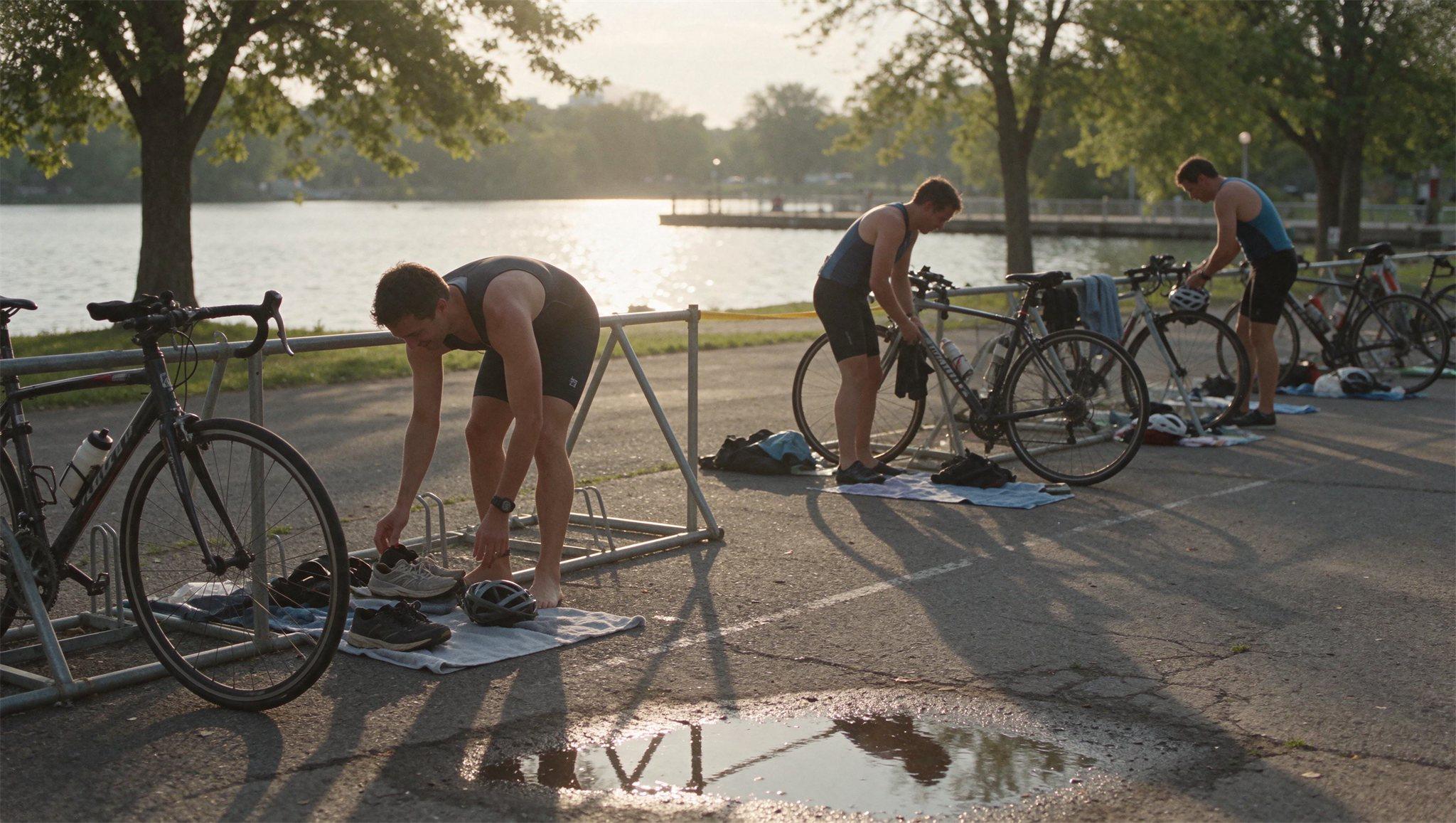
A brick is also transition practice. Set up your kit the way you will on race day, time the swap, and aim for under a minute, as the sprint and Olympic samples do.6 Practise the sequence: helmet off, shoes changed, race belt on.7
How Kovra schedules them
In Kovra a brick is one session: a long ride with a run straight after it (listed as “Long ride + brick run”). It isn’t in every week. Only build and peak weeks can have one, and Kovra plans at most one a week. Peak weeks have one, unless you’re injured, your legs are flagged tired, or you have too few hours or free days for a long ride. Build weeks have one if your plan is set to 9 hours a week or more. A brick needs a long ride, so it needs at least two rides that week, which in practice means more than about 5 hours of training that week. Running-only plans never have them.
When Kovra places your sessions, it avoids putting a run, a ride or a leg-strength session in the slot right before a brick, so you start it fresher. It doesn’t fix how long the run is. On a brick session you also get a short checklist, “Set up T2 before you leave”: running shoes by the door, gel and bottle, watch on multisport. More on how Kovra adapts.